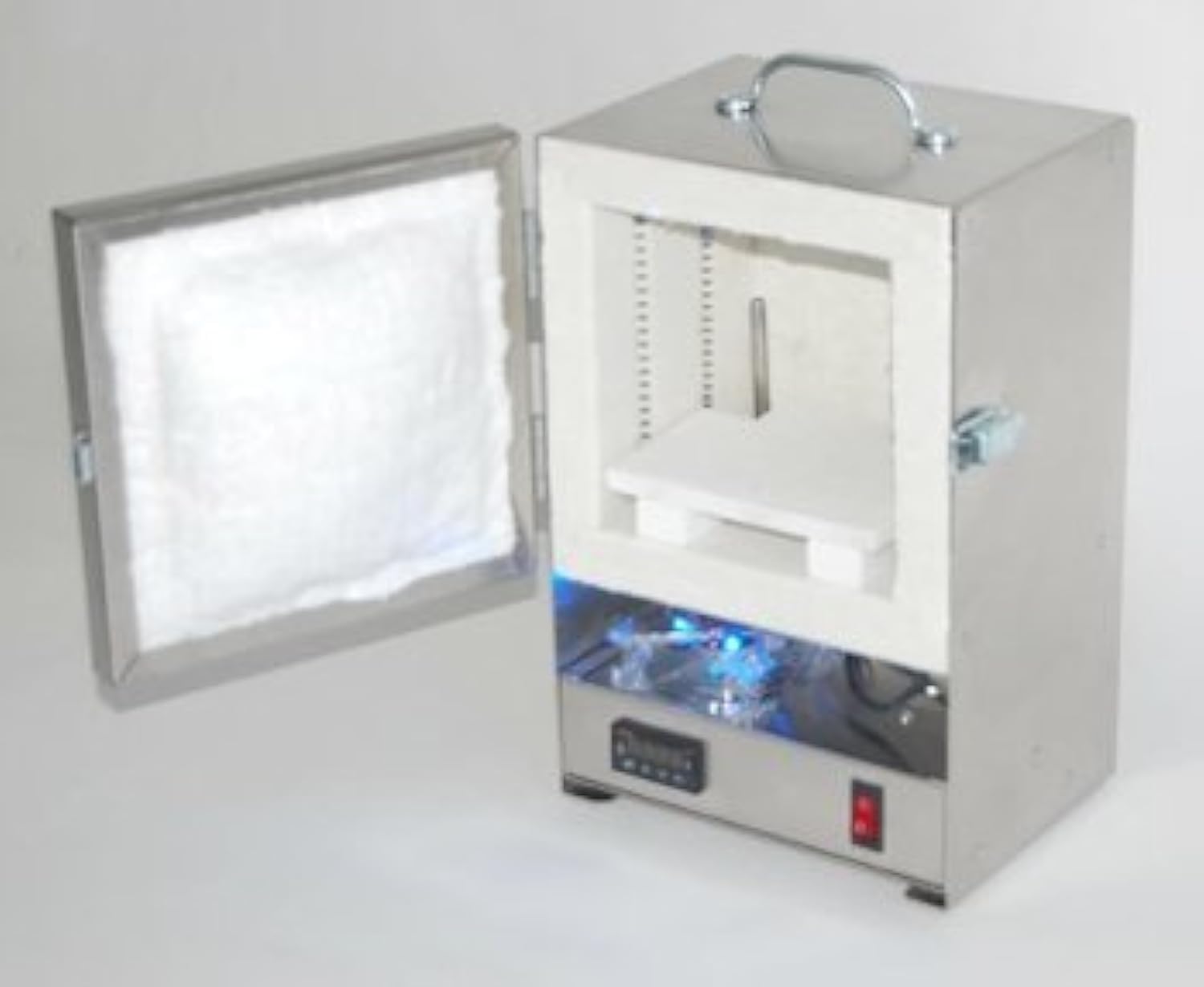
If you make jewelry from silver, bronze, or copper metal clay — a material that starts as a pliable paste, gets shaped like conventional clay, and then gets fired in a kiln (a small electric furnace) to burn away the binder and sinter the metal particles into solid metal — or if you do enameling (fusing powdered glass onto metal at high heat), you already know that a tabletop kiln sits at the center of your practice. What you may not have fully mapped out yet is what that kiln actually costs beyond the sticker price: electricity per firing, element (the coiled heating wire inside the kiln) replacement cadence, and the realistic parts budget over a three-to-five year ownership window. This article gives you that math, compares the leading models in the $300–$1,200 tabletop range, and ends with a clear decision rule so you can stop second-guessing and start ordering.
What “Tabletop Kiln” Actually Means for This Work
The term covers a specific category: compact, single-phase, plug-in kilns with interior volumes typically between 0.03 and 0.5 cubic feet, rated to temperatures between 1,650°F and 2,300°F (900°C–1,260°C). For metal clay and enameling, that temperature range matters more than interior volume, because the critical ranges are:
- Fine silver metal clay (PMC3, Art Clay Silver): 1,110°F–1,650°F (600°C–899°C), depending on the formulation
- Bronze and copper metal clay: 1,550°F–1,830°F (843°C–999°C), typically fired in activated carbon
- Torch-fired enameling: already handled outside the kiln, but kiln-fired enameling sits at 1,400°F–1,550°F (760°C–843°C)
Ceramic Arts Network’s firing guide for metal clay notes that most fine silver work fires successfully at cone 017 to cone 010 (roughly 1,300°F–1,650°F), which puts the majority of jewelry kiln work well within the range of even the most affordable tabletop units. The higher end of the range — bronze clay, high-fire copper clay — is where you need to pay attention to a kiln’s rated maximum temperature versus its sustained working temperature, a distinction that separates marketing copy from operational reality.
The Models Worth Knowing
Before the cost math, a quick map of the competitive set as of mid-2026:
Paragon SC-2 (~$350–$430): The entry point most metal clay instructors recommend first. Interior volume of roughly 0.05 cubic feet, rated to 2,000°F, 120V/12A plug-in. The SC-2 runs on a standard household outlet, which matters if you’re working in a rented studio or spare room with no dedicated circuit.
Paragon Caldera (~$575–$650): A clamshell-style kiln (the lid opens upward rather than having a front door) with better visibility into the chamber. Also 120V, rated to 2,300°F — high enough for bronze clay without pushing the element to its limits.
AIM Kilns 64 and 120 series (~$400–$650): AIM’s lineup, per their published specifications, emphasizes element longevity and uses a heavier-gauge element wire than some competitors. The AIM 64 is a direct SC-2 competitor; the AIM 120 offers more interior space for production runs or larger enamel pieces.
Jen-Ken AF3P (~$850–$1,100): The step up that professional enamellists and studio jewelers consistently cite in long-form reviews. Rated to 2,350°F, digital controller included, and — critically — Jen-Ken publishes element replacement part numbers and prices openly. Hotkilns.com (Jen-Ken’s distributor) lists element assemblies for the AF3P in the $45–$65 range as of this writing.
Skutt Firebox 8 and 14 (~$700–$950): Skutt’s entry into the jewelry/metal clay segment. The Firebox 14 has roughly double the interior volume of the Firebox 8, uses Skutt’s established element supply chain, and benefits from the brand’s well-documented service infrastructure — an advantage if you’re already in a Skutt ecosystem for a larger studio kiln.
The Per-Firing Cost Math You Actually Need
Most jewelry makers know their materials cost per piece. Fewer have run the electricity math on their kiln. Here it is.
A standard metal clay firing cycle for fine silver runs approximately 60–90 minutes total (ramp up, hold, cool-down begins). A bronze clay firing in carbon can extend to 2.5–3.5 hours including the controlled cool. Enameling firings are short — often 1–3 minutes at temperature — but you’re typically loading and firing 8–15 times per session, so total element-on time per session approaches 30–60 minutes at high draw.
Wattage for the common models:
- Paragon SC-2: 1,440W (120V × 12A)
- Paragon Caldera: 1,440W
- AIM 64: ~1,440W
- Jen-Ken AF3P: 1,500W
- Skutt Firebox 8: 1,440W
A 1,440W kiln running at full draw for 1.5 hours uses 2.16 kWh. At the U.S. national average residential electricity rate of approximately $0.16/kWh in early 2026 (per U.S. Energy Information Administration monthly data), that’s $0.35 per firing for a fine silver metal clay run. Bronze clay at 3 hours: roughly $0.69 per firing. A full enameling session at 45 minutes of cumulative element-on time: $0.17.
By the numbers — tabletop kiln per-firing electricity cost at $0.16/kWh:
| Firing Type | Element-On Time | kWh Used | Cost/Firing |
|---|---|---|---|
| Fine silver metal clay | 1.5 hrs | 2.16 kWh | ~$0.35 |
| Bronze/copper clay (carbon pack) | 3.0 hrs | 4.32 kWh | ~$0.69 |
| Kiln-fired enameling (full session) | 0.75 hrs | 1.08 kWh | ~$0.17 |
These numbers are small enough that electricity is not your cost problem. Your cost problem is elements.
Element Replacement: The Real Ownership Math
This is where the buying decision actually lives, and where the gap between models becomes concrete.
Elements in tabletop jewelry kilns are the spiral resistance wire that generates heat. They degrade. In a kiln used seriously — say, three to five firing sessions per week — element replacement is a real and recurring expense. Ceramic Arts Network’s maintenance guidance for small kilns suggests that a well-used tabletop kiln can see element degradation within 18–36 months depending on maximum temperature achieved, frequency of high-fire work, and whether the chamber is exposed to carbon contamination (a known accelerator for element degradation in bronze clay setups).
The replacement cost spread is significant:
- Paragon SC-2 elements: Paragon’s own parts documentation lists replacement elements in the $18–$28 range. Installation is DIY-accessible — owners in aggregated forum discussions describe a 20–30 minute swap with basic tools.
- AIM Kilns elements: Per AIM’s published parts pricing, elements for the 64 and 120 series run $25–$45. AIM’s heavier-gauge wire is cited by reviewers as a reason for their longer observed element life at sustained high temperatures.
- Jen-Ken AF3P elements: Listed at $45–$65 per element assembly at hotkilns.com. Higher upfront cost, but the AF3P’s published specs use a heavier element grade — owners in long-run reviews consistently note fewer replacement cycles over a five-year window.
- Skutt Firebox elements: Skutt’s parts infrastructure is robust and their element pricing sits in the $30–$55 range. The advantage here is supply chain reliability — Skutt’s distributor network means you’re unlikely to face a back-order situation that grounds your studio for weeks.
If you fire bronze clay regularly, carbon contamination is a genuine element-life variable that most entry-level buying guides underplay. Rio Grande’s metal clay resource guide explicitly recommends kiln separation — a dedicated kiln for carbon-pack firings — precisely because carbon residue accelerates element degradation in standard resistance-wire elements. If you’re doing mixed work (silver and bronze), account for a shorter element lifespan in your five-year cost model.
Rough five-year parts budget (serious hobby to light-production use):
- Paragon SC-2: 2–3 element replacements × $23 avg = $46–$69
- Jen-Ken AF3P: 1–2 replacements × $55 avg = $55–$110, but with lower replacement frequency
- Any kiln used for carbon-pack bronze clay: add one additional replacement cycle to your estimate
The SC-2 wins on raw parts cost. The Jen-Ken wins on frequency. Over five years at high-volume bronze clay use, they converge. At light silver-only use, the SC-2 is the clear value position.
Controller Quality and Firing Schedule Flexibility
For enameling, a manual infinite-switch controller (the dial style) is genuinely adequate — you’re firing visually, watching the enamel flow, and pulling the piece. The Paragon SC-2 ships with a basic manual control, which is appropriate for that workflow.
For metal clay, especially bronze and copper clay that require precise ramp rates and hold times (to prevent blistering and ensure complete carbon burnout), a digital programmable controller is worth the price difference. The Jen-Ken AF3P ships with a digital controller. The Paragon Caldera can be ordered with a digital upgrade. AIM’s 120 series offers a digital option.
If you buy an SC-2 and later want programmable ramps, aftermarket controllers exist — the Bartlett Genesis Nano and similar units are compatible — but adding one post-purchase pushes you into Jen-Ken pricing territory anyway. Factor that in if you know you’ll be doing serious bronze clay work from the start.
The Decision Rule
Here’s the “if X, then Y” framework based on the actual tradeoffs above:
If you’re a fine silver and enameling practitioner, firing 1–3 sessions per week, working from a standard 120V outlet, and want the lowest entry cost with reliable parts: the Paragon SC-2 is the rational choice. Parts are cheap, the brand is established, and the temperature ceiling is sufficient for everything you’ll fire.
If you’re doing mixed work — fine silver plus bronze clay — and anticipate volume growing to production-level output: spend the additional $400–$600 on the Jen-Ken AF3P or Skutt Firebox 14 now. The programmable controller, higher temperature rating, and documented element longevity at sustained high-fire use justify the upfront delta before your second element replacement cycle.
If carbon contamination is already part of your workflow (you’re actively firing bronze or copper clay in activated carbon packs): seriously evaluate a second dedicated kiln for that work rather than running it through your silver/enamel kiln. The element degradation math makes two inexpensive kilns cheaper over five years than one kiln cycled through mixed contaminating and clean work.
If you’re buying for a teaching studio, community center, or production bench where multiple users fire weekly: the Skutt Firebox series is the operationally sensible pick. Supply chain depth, brand familiarity, and distributor support outweigh the modest price premium in any institutional context.
For more on how tabletop kilns fit into a broader studio buildout, see our guide to entry-range kiln specs and electrical requirements and our metal clay firing temperature reference.