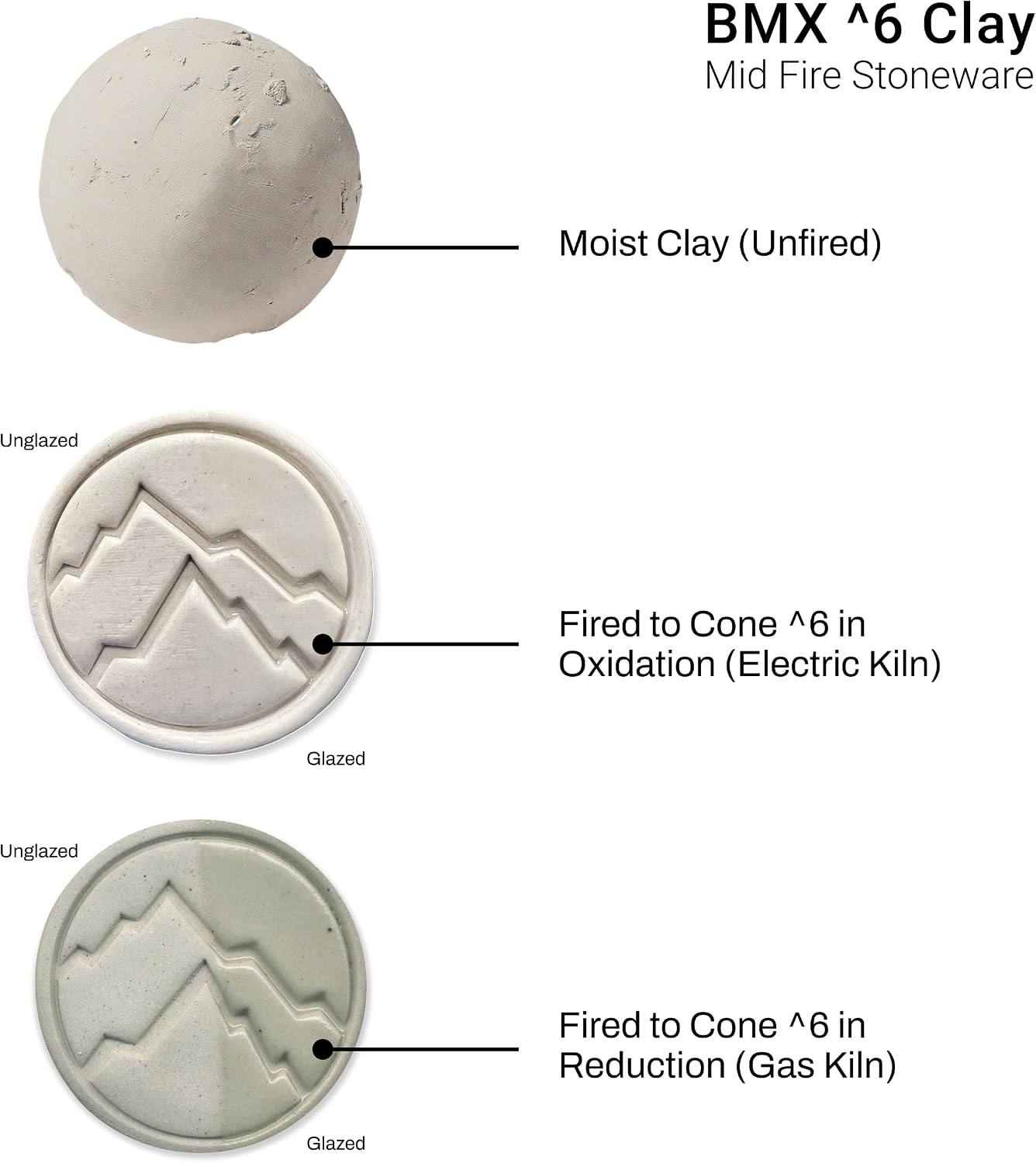
If you’ve ever pulled a piece out of the kiln looking chalky, warped, or glassy when it should have been matte, there’s a decent chance the problem started before you loaded the shelf — it started when you chose your clay. Clay bodies (the prepared mixtures of raw clay, grog, and minerals that potters and ceramic artists work with) are formulated to mature — fully fuse and harden — at specific temperatures. Those temperatures are expressed in cones, a numbered scale that correlates to how much heat the kiln delivers over time, not just peak degrees Fahrenheit. Cone 06 is relatively low-fire, around 1828°F. Cone 6 is mid-fire, around 2232°F. Cone 10 is high-fire, around 2350°F. Every clay body you buy has a rated cone range printed on the bag, and every kiln you own has a maximum cone rating stamped in its spec sheet. When those two numbers don’t align with your actual firing schedule — how often you fire, how fast, and at what peak — you get problems that cost you time, money, and work. This guide will help you match the right clay to your kiln and production rhythm before any of that happens.
Why Cone Range Isn’t Just a Temperature Number
The cone system is often misunderstood as a simple temperature lookup. It isn’t. A pyrometric cone (the small pyramid you sometimes see fused onto a kiln shelf) measures heat work — the combined effect of temperature and time. The Ceramic Arts Network’s practical guide on clay bodies explains this distinction clearly: a kiln that ramps slowly to 2232°F delivers more heat work than one that spikes to that same peak on a fast cycle, which is why two identical kilns firing the same clay can produce different results if their schedules differ.
This matters immediately when you’re making purchasing decisions about clay. If you’re running a production studio firing Cone 6 stoneware twice a week on an aggressive schedule — fast ramp, short hold — you’re applying less cumulative heat work than a studio doing slow, overnight firing to the same cone. Your clay choice needs to account for that. A clay body rated “Cone 6–10” that was formulated expecting a slow climb may come out underfired on your timeline.
Practical takeaway: Always ask the clay supplier — not just what cone the body targets, but what firing schedule it was developed on. Most manufacturers will tell you; Highwater Clays, Standard Clay, and Sheffield Pottery all publish this alongside their technical data sheets. Cross-reference it against your kiln’s documented firing schedules before you commit to a 50-pound bag, let alone a production run.
Matching Clay Cone Range to Your Kiln’s Real Ceiling
Every kiln has a rated maximum cone — the peak temperature the manufacturer certifies the elements, firebrick, and hardware to reach under normal conditions. Per L&L Kilns’ element life and cone rating FAQ, routinely firing to a kiln’s absolute maximum cone shortens element life measurably. The general guidance from L&L is that firing to one cone below the rated maximum for the majority of your production extends element replacement intervals significantly. On an L&L Jupiter (rated to Cone 10), firing predominantly at Cone 6 keeps you comfortably below that ceiling.
This has a direct consequence for clay selection:
- Entry-level kilns (Skutt KM-818, Paragon Caldera) are typically rated to Cone 10 but perform most consistently and economically at Cone 6 and below. If your clay body requires Cone 10 to mature, you’ll be pushing the kiln hard — and your elements will tell you about it.
- Mid-range workhorses (Skutt KM-1227, Paragon Dragon 24) can handle regular Cone 10 firing, though operators in long-run reviews note that element life still drops meaningfully when Cone 10 is the default rather than the exception.
- Production-grade, front-loading kilns (L&L Jupiter, Skutt 1227) are built for sustained high-fire cycling and are the right tool if Cone 10 stoneware or porcelain is your bread and butter.
By the Numbers
| Cone Target | Approx. Peak °F | Typical Clay Type | Practical Kiln Match |
|---|---|---|---|
| Cone 06–04 | 1828–1945°F | Earthenware, terra cotta | Any kiln rated Cone 6+ |
| Cone 6 | 2232°F | Mid-fire stoneware, porcelain | KM-818 to KM-1227 |
| Cone 10 | 2350°F | High-fire stoneware, porcelain | KM-1227, L&L Jupiter, Dragon 24+ |
Sources: American Ceramic Society ceramic engineering references; Skutt published kiln specifications.
Production Volume: The Variable Most Buyers Underestimate
Choosing a clay body isn’t just about whether your kiln can reach the right cone. It’s about whether your kiln can reach that cone reliably, repeatedly, at the frequency your production demands — without compressing element life so fast you’re replacing coils every six months.
Here’s the math that matters:
Scenario A — Hobbyist, 4–6 firings per month at Cone 6: An entry-level kiln running mid-fire stoneware at this pace will cycle elements well within designed tolerances. You have wide latitude on clay choice within the Cone 5–7 range. Focus your selection criteria on texture, shrinkage rate, and how the body accepts your glazes.
Scenario B — Small production studio, 12–16 firings per month at Cone 6: At this pace, you’re putting real cumulative heat work through the kiln. Per Skutt’s KilnMaster controller documentation, consistent multi-firing production schedules benefit from standardizing on a single clay body — fewer glaze-fit surprises, predictable shrinkage, and easier troubleshooting when something goes wrong. Studios at this volume commonly report (via Ceramic Arts Network community forums and NCECA studio standards discussions) that switching clay bodies mid-production creates more reject rates than the new body’s purported benefits justify.
Scenario C — Institutional or production studio, 20+ firings per month at Cone 10: At this intensity, clay body selection becomes a durability and cost-per-firing calculation. High-fire clays require more energy per firing cycle than mid-fire alternatives — not a trivial expense when you’re firing 240+ times a year. The American Ceramic Society’s ceramics engineering references document that the energy differential between a Cone 6 and Cone 10 firing in a standard electric kiln is roughly 15–25% more kilowatt-hours, depending on kiln size and insulation quality. At current 2026 commercial electricity rates averaging $0.12–0.18/kWh nationally, that adds up. Factor it into your clay body decision the same way you’d factor in glaze materials cost.
The Glaze-Fit Problem: Why Clay and Glaze Must Be Chosen Together
One of the most expensive mistakes in clay body selection is choosing the clay first and then retrofitting glazes to it. Glaze fit — whether a glaze’s thermal expansion and contraction rate matches the clay body’s — determines whether your finished pieces come out of the glaze firing with tight surfaces or with crazing (a network of fine cracks in the glaze layer) or shivering (glaze flaking off the surface).
Crazing is not just aesthetic. On functional ware — mugs, bowls, serving pieces — it creates sites for bacteria to accumulate and represents a structural vulnerability. Many studios have learned the hard way, after shifting to a new clay supplier mid-run, that their previously reliable glaze recipes started crazed and had to be reformulated.
If X, then Y decision rule:
- If you’re buying clay to match existing, tested glazes: Ask your supplier for the clay body’s coefficient of thermal expansion (COE) and compare it to your glaze’s documented COE. Your glaze supplier should have this number. Ceramic Arts Network’s technical library has published COE matching guides that walk through acceptable tolerance ranges.
- If you’re building a system from scratch: Choose your clay body first based on cone range and texture needs, then select glazes formulated for that specific body. Many suppliers (Laguna Clay, Standard Clay, Sheffield Pottery) sell glaze sets matched to their own clay lines precisely to avoid the fit problem.
- If you’re producing functional ware for sale: Don’t skip a glaze-fit test cycle. Fire a small test batch, run the ware through a dishwasher cycle, then examine under magnification. NCECA studio standards documentation recommends this as minimum due diligence before any production run.
Specialty Disciplines: When Standard Cone Guidance Doesn’t Apply
If your practice falls outside conventional stoneware and earthenware — metal clay, porcelain jewelry, raku, or glass work — the cone framework shifts substantially.
Metal clay (fine silver or bronze clay) fires at much lower temperatures than ceramic clay — typically 1200–1650°F depending on formula — in small programmable kilns like those from Paragon or AIM Kilns. The clay body question here is less about cone range and more about hold time and ramp rate: silver clay is sensitive to rapid temperature changes that cause surface cracking before the binder burns out. AIM Kilns’ published firing schedules for PMC (Precious Metal Clay) specify multi-segment ramps that most entry-level kilns with basic analog controls can’t execute precisely enough for consistent results.
Raku firing operates at Cone 06–04 (around 1800°F) but uses a post-firing reduction process — pulling work from the kiln while glowing hot and placing it in a container with combustible material. The clay body for raku must tolerate extreme thermal shock; groggy, open-bodied clays formulated specifically for raku (available from most major suppliers) are non-negotiable. Standard stoneware or porcelain will not survive the process reliably regardless of cone rating.
Porcelain jewelry typically fires in the Cone 6–10 range but at very small scale, often in compact test kilns or jewelry kilns where temperature uniformity across a tiny interior matters more than the cone ceiling itself. Paragon’s SC-2 and similar small-chamber kilns are commonly specified for this application; operators consistently report that interior hot spots in larger kilns create uneven color development in translucent porcelain pieces.
The Clear Decision Framework
You now have the variables. Here’s how to stack them:
If you fire mid-fire (Cone 6) on a moderate schedule (under 12 firings/month): You have the widest clay choice. Prioritize texture, color response, and glaze compatibility. Almost any mid-range electric kiln will serve you well.
If you fire Cone 10 regularly: Match your kiln to it first — confirm your kiln is spec’d and in condition for sustained high-fire work — then choose a clay body formulated for slow, full-maturation firing and verify your elements are in serviceable condition before committing production work.
If your volume is high (12+ firings/month): Standardize on one clay body and don’t change it mid-run. The savings from “a better deal” on a different clay bag disappear instantly when reject rates climb and you’re reformulating glazes.
If your discipline is specialty (metal clay, raku, porcelain jewelry): Start with the clay body’s specific technical requirements and work backward to kiln selection — not the other way around.
The clay body in your studio isn’t a commodity line item. It’s the foundation that every firing schedule, glaze recipe, and production projection is built on. Get it right before you load the kiln.